Traffic channels and sources
How Privatus Analytics classifies every visit into a traffic channel from UTM parameters and the referrer, including AI assistants and custom channel rules.
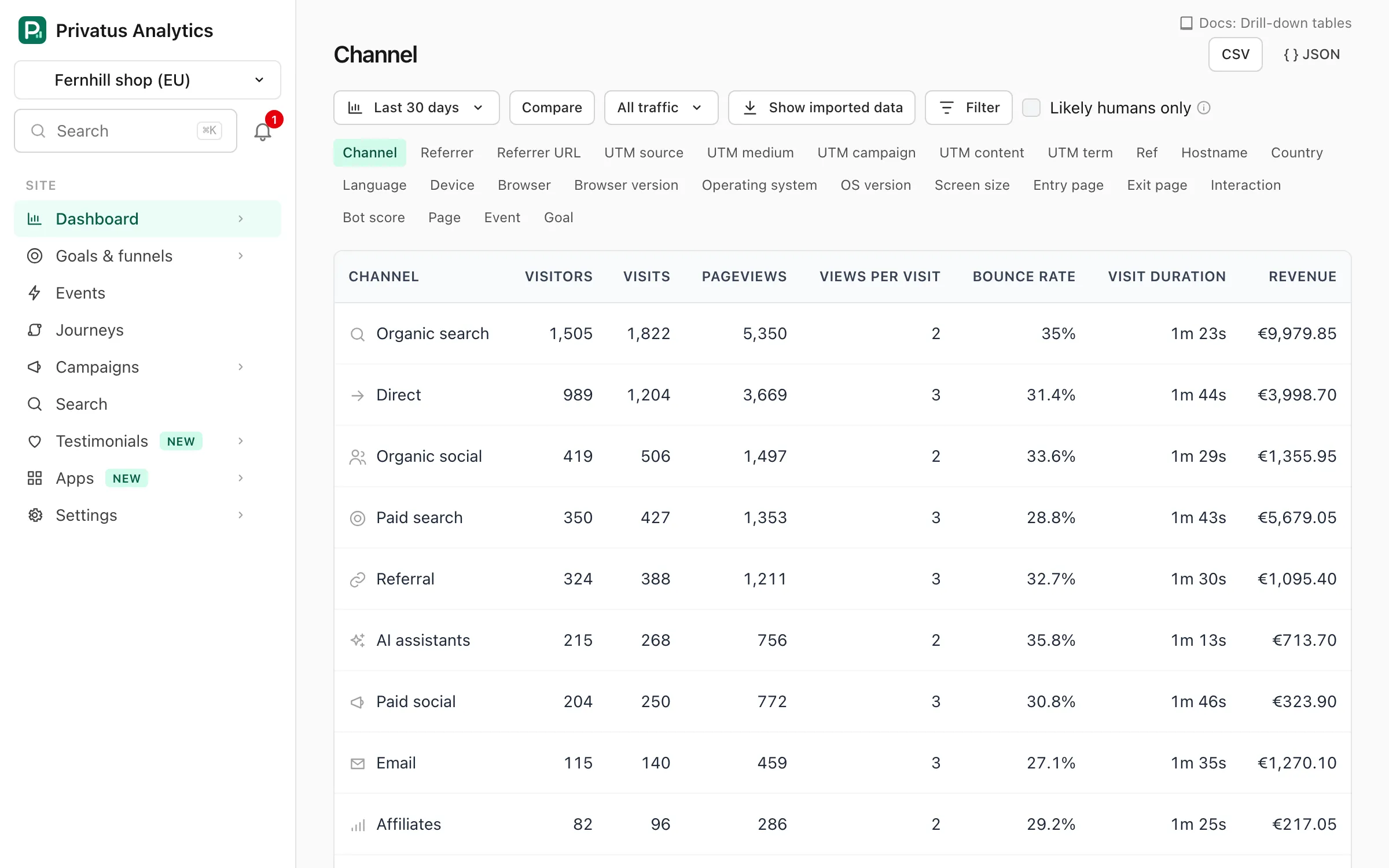
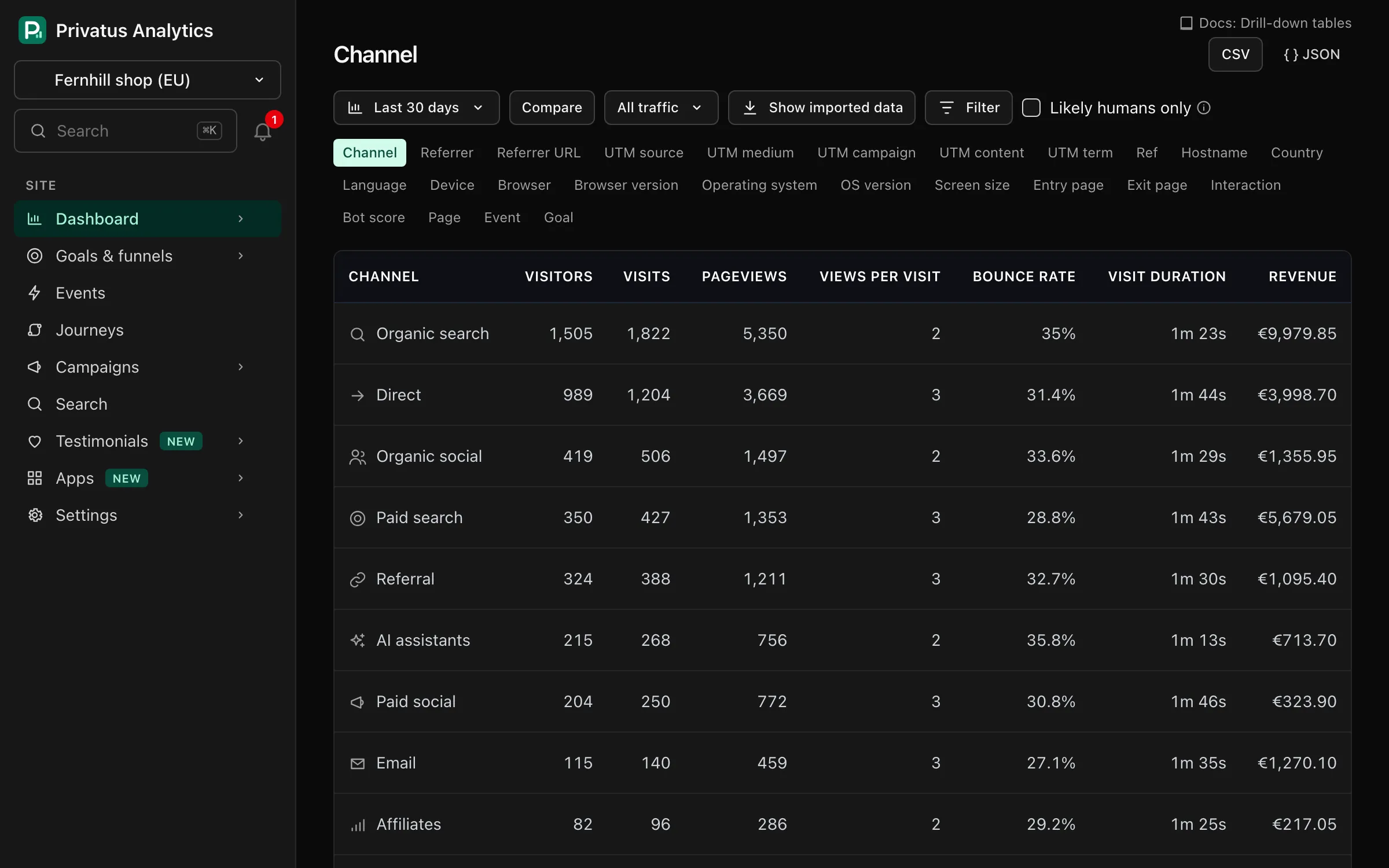
Every visit gets one channel, from the landing page's campaign parameters and the referrer of its first hit. Rules are checked in this order, and the first match wins.
| Channel | Rule |
|---|---|
paid_search |
A paid click id (gclid, msclkid…) or paid utm_medium from a search engine |
paid_social |
A paid click id or paid utm_medium from a social network |
paid_other |
Any other paid traffic. Paid mediums: cpc, ppc, paid, paidsearch, paid_search, cpm, cpv, display, banner, affiliate, paid_social, paidsocial |
email |
utm_medium containing email, or newsletter. Webmail: mail.google.com, outlook.live.com, outlook.office.com, mail.yahoo.com, mail.proton.me, app.fastmail.com, mail.aol.com |
ai_assistants |
Any .ai referrer, chatgpt.com, chat.openai.com, perplexity.ai, claude.ai, gemini.google.com, bard.google.com, copilot.microsoft.com, you.com, phind.com, meta.ai, grok.com, chat.mistral.ai, chat.deepseek.com, poe.com. Also utm_source chatgpt, chatgpt.com, openai, perplexity, claude, gemini, copilot, grok, deepseek, mistral |
organic_search |
google, bing, duckduckgo, yahoo, yandex, baidu, ecosia, qwant, startpage, brave, naver, seznam, ask, aol, search.yahoo, kagi, mojeek, sogou, so.com. Also utm_medium organic, search |
organic_social |
facebook.com, instagram.com, t.co, twitter.com, x.com, linkedin.com, lnkd.in, reddit.com, youtube.com, tiktok.com, pinterest.com, snapchat.com, threads.net, bsky.app, mastodon.social, news.ycombinator.com, whatsapp.com, telegram.org, discord.com, quora.com, tumblr.com, vk.com, weibo.com, producthunt.com. Also utm_medium social, social_media, sm, social-network |
internal |
A referrer on one of the site’s own domains |
referral |
Any other referrer or utm_source |
direct |
No referrer and no campaign parameters |
How the rules match:
- Paid means a click id on the landing page URL, or a paid
utm_medium. A paid visit ispaid_searchwhen it comes from a search engine, or its medium iscpcor containssearch. Otherwise it ispaid_socialwhen it comes from a social network or its medium containssocial. Every other paid visit ispaid_other. - Search engines match the referrer's hostname (
googlematchesgoogle.com,google.deand so on) or autm_sourceequal to the engine's name. - Social networks, webmail and AI assistants match the referrer's
domain and its subdomains. A
utm_sourceequal to the first part of a social domain (facebook,linkedin,reddit) also counts as social. utm_sourceandutm_mediumare compared in lowercase.
Click ids (gclid, gbraid, wbraid, msclkid, fbclid, ttclid,
li_fat_id, twclid, dclid) mark a visit as a paid click. They're kept
only as a yes/no flag. The id itself is discarded. Some networks add
their click id to unpaid links too (Facebook adds fbclid to most links),
and those visits count as paid as well.
Referrers, sources and campaigns#
- Referrer is the hostname the visitor came from, with a leading
www.,m.,l.,lm.,mobile.oramp.removed. Its path is stored too (for thereferrer_urldimension). The referrer's query string is never stored. Referrers from the site's own domains and their subdomains are internal: the visit's referrer is left blank, and its channel isinternalunless an earlier rule matched. - UTM parameters (
utm_source,utm_medium,utm_campaign,utm_content,utm_term) come from the landing page URL. refis taken from theref,viaorsourcequery parameter of the landing page URL (the first of the three that has a value).
A visit keeps the source it started with (first touch): later pages of the same visit don't change it.
Custom channel rules#
Site settings → Channels lets you add your own rules. They are checked from top to bottom before the built-in ones, and the first match wins. Use the arrows to move a rule up or down.
Each rule has a channel name (up to 32 characters, your own or a built-in one) and conditions that must all match. The form takes up to three conditions, and the API up to five. A site can have up to 25 rules.
| Field | What it is compared with |
|---|---|
referrer_host |
The referrer's hostname, as described above |
utm_source, utm_medium, utm_campaign |
The landing page's UTM parameters |
ref |
The landing page's ref, via or source parameter |
path |
The landing page's path |
| Operator | Matches when the field |
|---|---|
is |
equals the value |
contains |
contains the value |
starts_with |
starts with the value |
regex |
matches the regular expression (up to 200 characters, without backreferences) |
All four ignore case.
Example: channel Partners when ref starts_with partner-. Rules apply
to new visits. Visits already stored keep their channel.
Preview takes a sample visit (referrer, landing page, utm_source,
utm_medium, utm_campaign, ref) and shows the channel it would get,
and whether a custom rule or the built-in list decided it.
Over the API and MCP: channel_rules_list, channel_rules_create,
channel_rules_update, channel_rules_delete, channel_rules_move and
channel_rules_preview.