Google Search Console and Bing integration
Connect Google Search Console and Bing Webmaster Tools to see queries, clicks, impressions and rankings next to the visits and conversions each page brings.
Connect#
Watch: Which Google searches bring customers? Search Console + sales (2:09)
Which Google searches bring you customers, not just clicks? Search Console connected to your sales, read-only, with nothing handed back to Google.
Transcript
You show up for thousands of searches. Which ones bring you customers? Search Console shows you clicks. It never shows you sales.
I'm James, founder of Privatus Analytics. Let me put the two together for you.
Your search data lives in one place. Your sales live in another. So you know your best page gets two thousand clicks a month from Google. What you don't know is whether a single one of them bought anything. Joining the two means exports, a spreadsheet, and an afternoon you don't have. So it doesn't get done. Instead you write more of what ranks. More pages like the one with the clicks, and the sales don't move, because that page was never the one selling. The page quietly bringing in customers gets no attention, because it never looked impressive in Search Console. And the usual fix is to hand Google even more. Link everything to Google Analytics, so the ad company gets your search data and your sales data in one place. Months of SEO effort, pointed at the wrong pages, with Google watching the whole time.
With Privatus Analytics, connect Google Search Console, and Bing too, with read-only access. We read your search data. Google gets nothing back. Then the two halves meet. For every page your searches land on, you see what those visitors did next. Who signed up, who bought, who left. That's how you find the page that ranks well but never sells, and the one quietly bringing in customers. Then it shows you the easy wins. Pages people see in search but rarely click, where a better title would bring more. And pages sitting just off the first page of Google, ready for a push. Or ask Claude or ChatGPT, over MCP, which searches brought you signups.
Now you know which searches bring customers, not just clicks. Your SEO effort goes to the pages that sell. And there's no spreadsheet to build, and nothing more handed to Google.
Find the searches that sell. Start free at privatusanalytics.com.
Open the site's Search page (also linked from Site settings →
Integrations). Click Connect with Google, grant read-only
access, and choose the property that matches the site. Connecting,
syncing and disconnecting need the sites.manage permission.
Bing Webmaster Tools#
Bing connects with your own Bing Webmaster API key:
- Sign in to Bing Webmaster Tools with the account where the site is verified. Only sites verified in that account appear in the list.
- Click Settings (the gear icon) > API access > API Key, and copy your key.
- On the Search page, switch to the Bing Webmaster Tools tab, paste the key and click Load sites.
- Pick the site and click Connect.
We store your key encrypted and only use it to read search performance for the site you choose. It is never shown again or returned by the API. You can revoke it in Bing Webmaster Tools at any time. If Bing stops accepting it, the Search page asks you to paste a new one, and connecting again with a new key replaces the old one. Each site has its own key.
Connecting, to Google or to Bing, is in the app only, never over the API
or MCP, since Bing takes your key. Over the API or MCP,
search_report, search_sync and search_disconnect read the report,
start an import and disconnect. Over MCP search_disconnect only returns
a link to this page, see Actions for a person.
The first import brings in the last 90 days. After that we sync the data daily, and Sync now imports straight away. Search engines publish it with a delay of two to three days, so the most recent days are always empty, and the report shows a warning for them.
Disconnect at any time. The synced data, and for Bing your stored API key, is deleted with the connection.
The report#
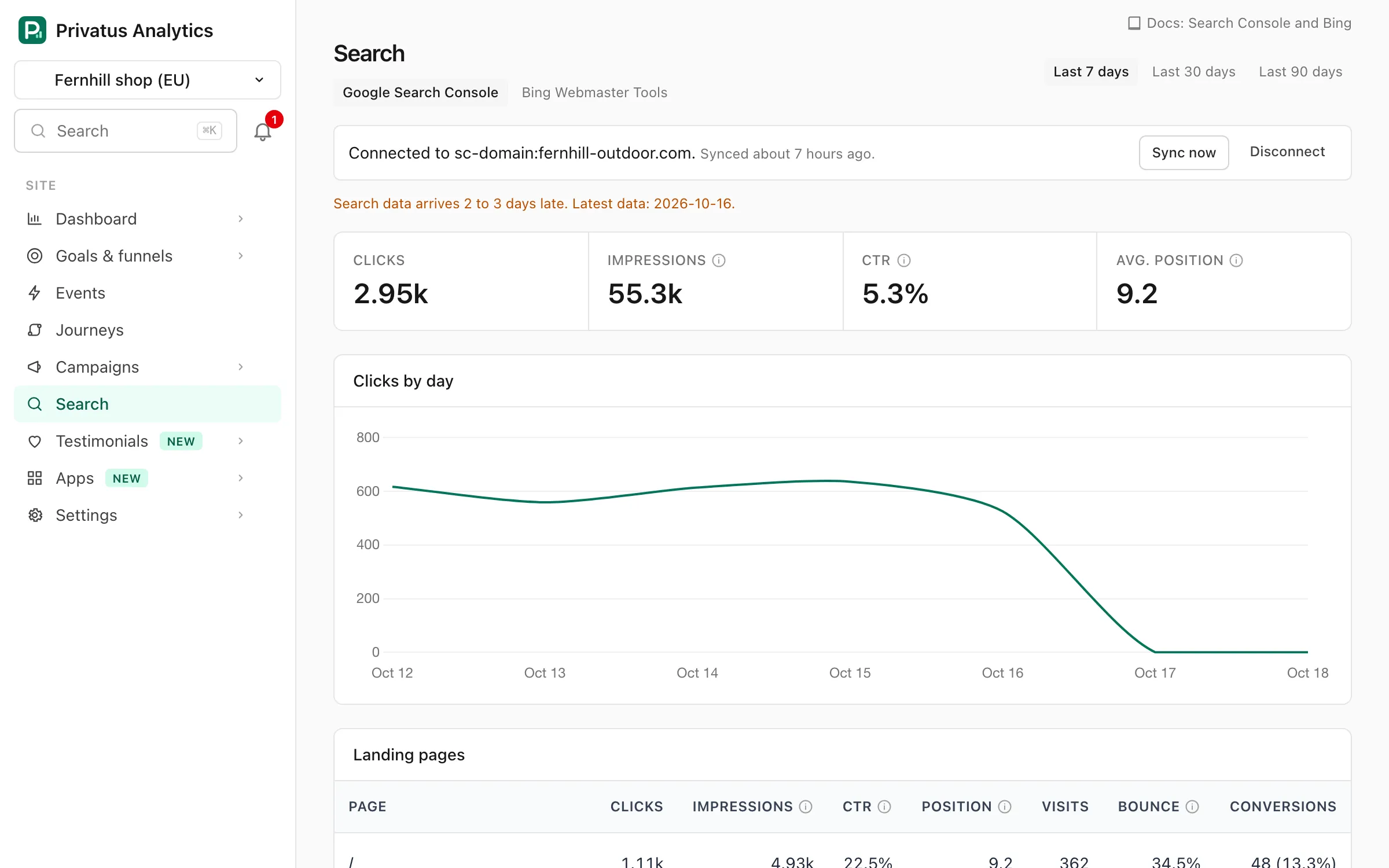
The All tab, the one that opens first, adds every connected search
engine together: clicks and impressions are summed, and the average
position is weighted by impressions across both. Countries and devices
come from Google Search Console only, because Bing doesn't report them.
The Google Search Console and Bing Webmaster Tools tabs show one
engine on its own, and are where you sync or disconnect it. The
dashboard's date range applies. Over the API and MCP,
provider is all by default, or google or bing.
- Totals and Clicks by day: clicks, impressions, click-through rate and average position.
- Top queries, Countries and Devices, each with clicks, impressions, click-through rate and average position (the top 25 rows).
- Landing pages: each page's search clicks next to the Privatus Analytics visits that entered on that page in the same period (from any source), with their bounce rate and conversions. A visit converts when it completes any of the site's goals. This is an aggregate join by path. Nothing about individual people is involved.
- Opportunities: the ten queries with the most impressions that have at least 100 impressions and a click-through rate under 2%, and the ten pages with the most impressions at an average position of 8 to 20.
Bing reports queries and pages by week#
Bing gives daily numbers only for the whole site. The totals and the Clicks by day chart use those. Bing reports queries and pages once a week, and only the top ones, so those tables add up to less than the totals, and a short period can show fewer rows than you expect.
Why search numbers don't match visits#
Search clicks come from Google or Bing, visits from your site. They differ because of blockers, visitors who leave before the page loads, bots, and the search engines' own anonymised-query filtering.